
There was a time when crossing the Pacific was a nautical undertaking.
Ships connected the islands.
Then Aircraft made the journey quicker, but the early machines still puddle jumped from one small airfield to another.
Then came the jet.
And something rather important happened.
The Pacific became smaller.
We still have an absurd amount of ocean surrounding remarkably small pieces of land.
But psychologically; Brisbane, Auckland, Honolulu and eventually the wider world were no longer weeks away. They were hours away.
That change arrived at almost exactly the same time that a generation of Pacific leaders were asking another rather unsettling question:
Why are others governing us?
It would be fanciful to suggest that the jet caused Pacific independence. It didn’t.
But it certainly arrived at a useful moment.
Suddenly Neighbours were actually Neighbours
The first South Pacific Forum met in Wellington in 1971.
Around the table were leaders from Fiji, Tonga, Western Samoa, Nauru and the Cook Islands, together with Australia and New Zealand.
They talked about trade, shipping, tourism, education, law of the sea — and aviation.
The following year aviation was again on the agenda. Pacific leaders already understood that isolation made air communications unusually important and that cooperation between countries and airlines had advantages.
This was not some modern consultant discovering regionalism.
They understood the problem fifty years ago.
The islands were becoming politically independent at the same time as technology was making it possible for their leaders to meet one another, compare experiences and discover that colonial problems were not unique to their own little patch of ocean.
That mattered.
Independence Acquired a Boarding Pass
The founding generation could travel.
They could attend regional meetings.
They could go to London, Paris, Canberra, Wellington and the United Nations.
They could seek allies.
They could see other countries governing themselves.
And perhaps most importantly, they could come home having seen that the world was considerably larger than the colonial administration waiting for them at the airport.
Walter Lini provides a wonderful glimpse of this new world.
During the New Hebrides independence struggle, London and Paris wanted political leaders to travel overseas for constitutional negotiations. Lini later recalled that his party deliberately refused to board one such flight, insisting that negotiations should occur in Vila instead.
Only a generation earlier, refusing to fly to London would have been a largely theoretical gesture.
By the 1970s, getting onto — or deliberately not getting onto — an aircraft had become part of Pacific politics.
Then the Airlines Became National Too
The early Pacific aviation system was not originally composed of neat little national flag carriers competing with one another.
There was much more overlap.
Air Pacific, later renamed Fiji Airways, increasingly became a regional enterprise. Governments including Nauru, Tonga, Western Samoa, Solomon Islands and the Gilbert Islands participated in it.
And the aviation technology was advancing quickly.
In the early 1970s Air Pacific expanded jet services through the region using the BAC One-Eleven, while Pacific island runways were being upgraded to accept the new generation of aircraft.
The first generation of Pacific political regionalism and the first generation of Pacific jet travel were arriving together.
Then independence began changing the equation.
A newly independent country did not merely want access to aircraft.
It wanted its aircraft.
Its flag.
Its name on the fuselage.
Its route to the outside world.
That was hardly foolish.
These were new nations asserting themselves after decades of being administered by others.
A national airline looked rather like a national bank, a parliament or a broadcasting service.
It said:
We are here.
Nauru Spread Its Wings Early
Few countries embraced that idea more enthusiastically than Nauru.
Air Nauru began experimental services between Nauru and Brisbane in 1970 with a chartered Dassault Falcon 20.
Then the phosphate-rich republic went shopping.
Its first aircraft owned outright were Fokker F28 Fellowship jets. The first arrived in 1972, followed by another in 1974.
Those aircraft connected Nauru through Honiara, Nouméa and Brisbane and north through Micronesia toward Guam and Japan.
A Boeing 737-200 followed in 1975 and a 727 in 1976.
Think about that for a moment.
A tiny island republic with only several thousand people suddenly possessed jet aircraft capable of stretching its reach from Australia through the central Pacific toward Asia.
By 1983 Air Nauru had seven aircraft.
It eventually became financially extravagant, certainly.
But looked at through the eyes of a newly independent country, the attraction is easy to understand.
For perhaps the first time in Nauru’s history, geography was no longer entirely dictating its place in the world.
Jet engines were.
Kiribati Found the Same Freedom
The Gilbert Islands became Kiribati in 1979.
Its predecessor carrier, Air Tungaru, had been established in 1977 and later operated a Boeing 727-100 on international services between Tarawa and Honolulu via Kanton or Kiritimati.
Again, consider the geography.
Tarawa to Honolulu.
A country scattered across an enormous section of the Pacific suddenly had a jet-age bridge into the wider world.
The aircraft was not merely transport.
It altered what was conceivable.
Solomon Islands Took a Different Road
Solomon Airlines came from humbler commercial beginnings.
Laurie Crowley established Megapode Airways in 1962 as a small charter operation. Macair of Papua New Guinea acquired it in 1968 and renamed it Solomon Island Airways — SOLAIR.
Government ownership came gradually.
The jet itself initially belonged to other people.
In 1973 Air Pacific inaugurated direct Honiara-Brisbane services, and the first Boeing 727 landed at Henderson in 1977 as airport facilities were being upgraded for independence.
Solomon Airlines did not operate a jet in its own right until much later.
In 1990 it leased a Boeing 737-200. Before that it had relied on an Air Pacific 737 wet lease for Brisbane services.
That distinction is worth remembering.
Solomon Islands had international jet connectivity long before Solomon Airlines needed to own — or even independently operate — the jet providing it.
Vanuatu Repeated the Pattern
Vanuatu’s story is equally revealing.
Before independence, overseas air connections were largely part of wider regional networks.
Then independence came in 1980.
A national carrier followed.
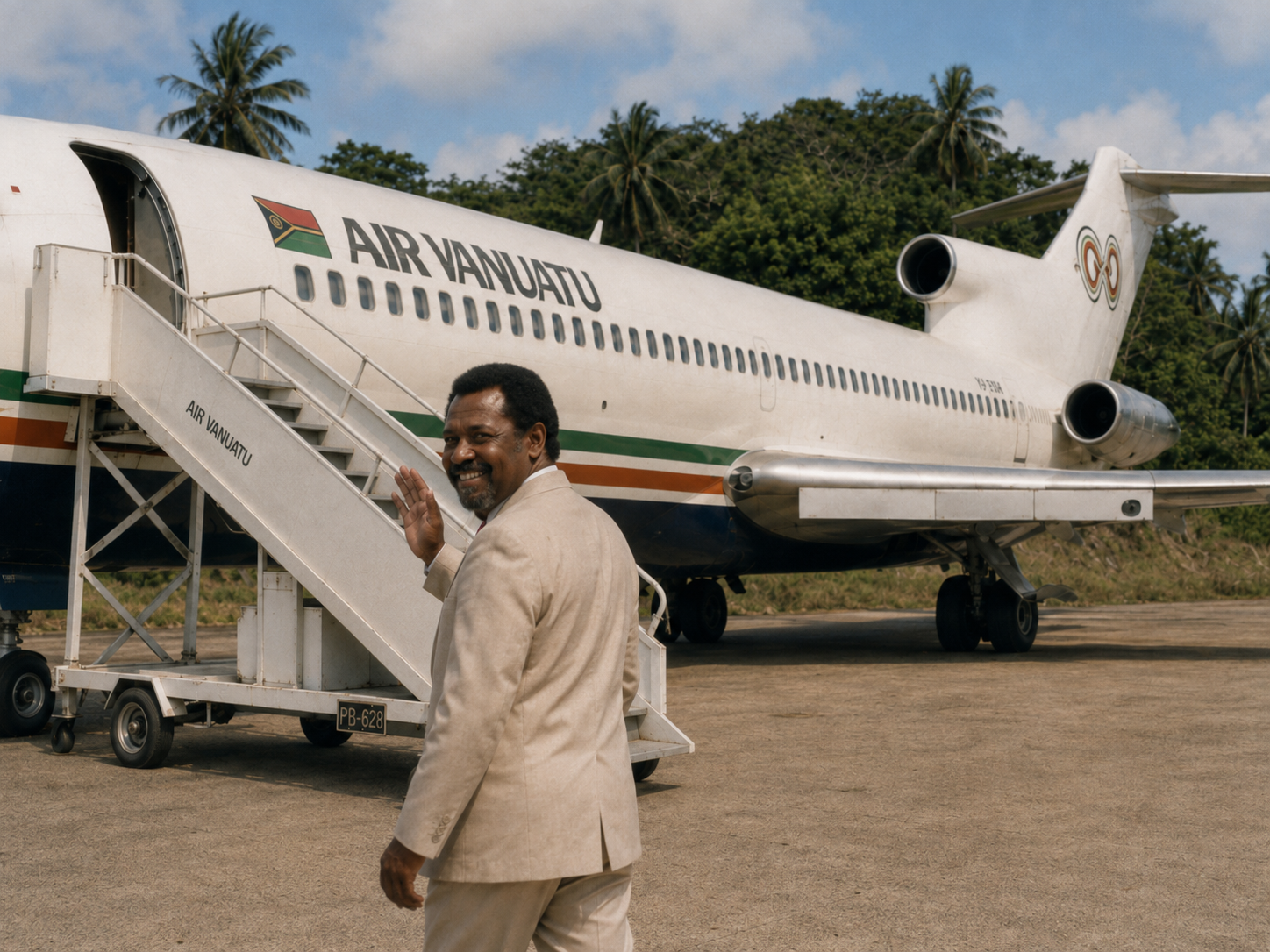
Air Vanuatu’s early international services were not built around a newly purchased Vanuatu jet. Ansett provided the machinery, beginning services from Australia in 1981 using a DC-9 and later Boeing 737 equipment.
The later incarnation of Air Vanuatu began in 1987 with a chartered Boeing 737-200 to Sydney.
In 1989 it purchased its first aircraft of its own, a Boeing 727-200 named Spirit of Vanuatu.
So again the sequence was:
first obtain the connectivity; then acquire the national aircraft.
Somewhere along the way those two ideas became almost inseparable.
The Jet Changed More Than the Timetable
The jet did not just change how quickly people travelled.
It changed what Pacific governments imagined their countries could be.
It allowed the independence generation to spread its wings, literally and politically.
Leaders could meet other leaders.
They could seek support overseas.
They could compare governments, economies and institutions.
They could begin to develop a world view rather than a colonial view.
But the jet changed the economics as well as the imagination.
A small propeller aircraft could connect small populations.
A jet wanted passengers.
Lots of them.
It needed longer runways, more fuel, specialised engineering and a network capable of keeping an expensive machine moving.
The aircraft that liberated island nations from distance also created a new dependency.
They had to be filled.
So the traveller became precious.
From Regional Partners to Competitors
By the mid-1970s Pacific governments were already debating whether the shared regional airline model could survive.
At the 1974 South Pacific Forum, leaders considered whether the regional airline should continue or whether each country should concentrate instead on its own national operation.
That may have been one of the pivotal moments in Pacific aviation.
The newly independent countries understandably chose increasing aviation sovereignty.
And from there emerged a different culture.
Each airline needed passengers.
Each protected routes.
Each sought government support.
Each wanted its own international services.
The airlines that might once have been components of a regional transport system increasingly became competitors for what was then the scarce resource:
travellers.
There was not much reason for industry camaraderie.
Your passenger was potentially my passenger.
Your new route might weaken mine.
Your government subsidy could threaten my service.
The flags might all have been Pacific, but commercially they were facing one another across the aisle.
Yet the Leaders Were Thinking Regionally
Here lies one of the lovely contradictions.
Politically, the Pacific’s founding generation was becoming more regional.
The South Pacific Forum had been created in 1971.
Pacific leaders were discussing fisheries, shipping, trade, independence, nuclear testing, law of the sea and their common place in the world.
By 1976 they were specifically calling for rationalisation of regional airline routes and schedules and better coordination of aviation.
In 1979 the Forum welcomed creation of the Association of South Pacific Airlines, again with the purpose of considering rationalised routes, schedules and equipment.
So the instinct for cooperation never entirely disappeared.
But the national airlines were growing up inside a competing commercial structure at exactly the same time.
Fifty Years Later the Scarcity Has Moved
This history matters because the underlying problem has changed.
In the 1970s the difficult question was:
Can we find enough travellers to support all these new national jet services?
Today there are considerably more travellers.
Tourism has grown.
Pacific populations travel more.
Families are spread between countries.
Labour mobility has increased.
Governments travel.
Business travels.
Freight moves by air.
The scarcity increasingly appears somewhere else.
Aircraft capacity.
One aircraft goes out of service and an airline can lose a large part of its international network.
Another carrier is called to help.
A wet lease is sought.
Passengers are transferred.
Another airline’s aircraft fills the hole.
Curiously, that begins to look rather like the regional aviation world we started with.
Perhaps History Is Circling Back
There is no obvious reason to recreate the old Air Pacific.
The world has changed too much.
More importantly, modern aviation no longer requires one organisation to own every part of an airline.
Aircraft are leased.
Operators provide aircraft and crews.
Engineering is contracted.
Reservation systems are shared.
Training is outsourced.
Maintenance may occur thousands of kilometres from the airline whose name is painted on the aircraft.
In computer language, an airline has become a stack.
Aircraft access is one layer.
Engineering another.
Crews another.
Training another.
Reservations another.
Freight another.
Maintenance another.
Disruption recovery another.
The national brand is simply what the passenger sees sitting on top.
And strangely enough, the Pacific already has pieces of that stack scattered around the region.
Nauru has aircraft, freight capability and a substantial Brisbane operation.
Solomon Airlines has international operating experience.
Kiribati has again been experimenting with separating aircraft ownership from aircraft operation.
Vanuatu has demand but very little international fleet depth.
The pieces are there.
They simply grew up under different flags.
Perhaps the Old Rivalry Has Outlived the Shortage That Created It
That may be the more interesting question for today’s airline professionals.
Pacific carriers inherited a culture formed when the traveller was scarce.
Protect the passenger.
Protect the route.
Protect the airline.
But if the scarcer commodity today is reliable aircraft capacity, cooperation begins to look different.
What aircraft do you have?
What aircraft do we need?
What engineering capability can be shared?
Who can recover whose passengers?
Who has crew?
Who has freight?
Where does somebody have unused capacity while somebody else has unmet demand?
It may be enough, at first, for airline people simply to compare notes.
Call that an Aelan Alliance if a name helps.
Or call it nothing at all.
We May Have Been Here Before
The amusing thing about supposedly new ideas is how often they turn out to be old ones wearing cleaner clothes.
The Pacific’s first jet-age leaders understood both sides of aviation.
Aircraft could carry a newly independent nation into the world.
But small island countries also needed one another.
The jet age helped them spread their wings, meet their neighbours and develop a world view larger than the colonial boundaries they inherited.
Then independence encouraged each country to build its own wings.
Fifty years later perhaps the next step is not giving those wings up.
It is remembering that they are all flying through the same sky.
And that may be where Pacific aviation began in the first place.